
How to use laddering to regulate your nervous system with ADHD
When your whole body feels restless, you’re stuck in the ADHD freeze, or you can’t let go of anger – then it’s time to look at the polyvagal ladder.

When you live with ADHD your emotions and energy can kind of feel like a rollercoaster – you might be feeling upbeat and energetic the next minute then frozen and stuck in endless procrastination the next.
One moment you’re buzzing with ideas and urgency – the next, you’re feeling flat, heavy, and checked out.
This isn’t a motivation issue. It’s a nervous system issue – and when you understand how your nervous system moves through different states (and how to support it) it becomes easier to start regulating your emotions and your state of mind.
That’s where the polyvagal ladder comes in.
The poly-what ladder?
Your autonomic nervous system (the part that runs automatically – controlling your heart rate, breathing, digestion, etc.) constantly scans for signs of safety or danger. Depending on what it perceives, it shifts into one of three main states.
Polyvagal theory organizes these states into a ladder – because we move up and down them, sometimes many times a day.
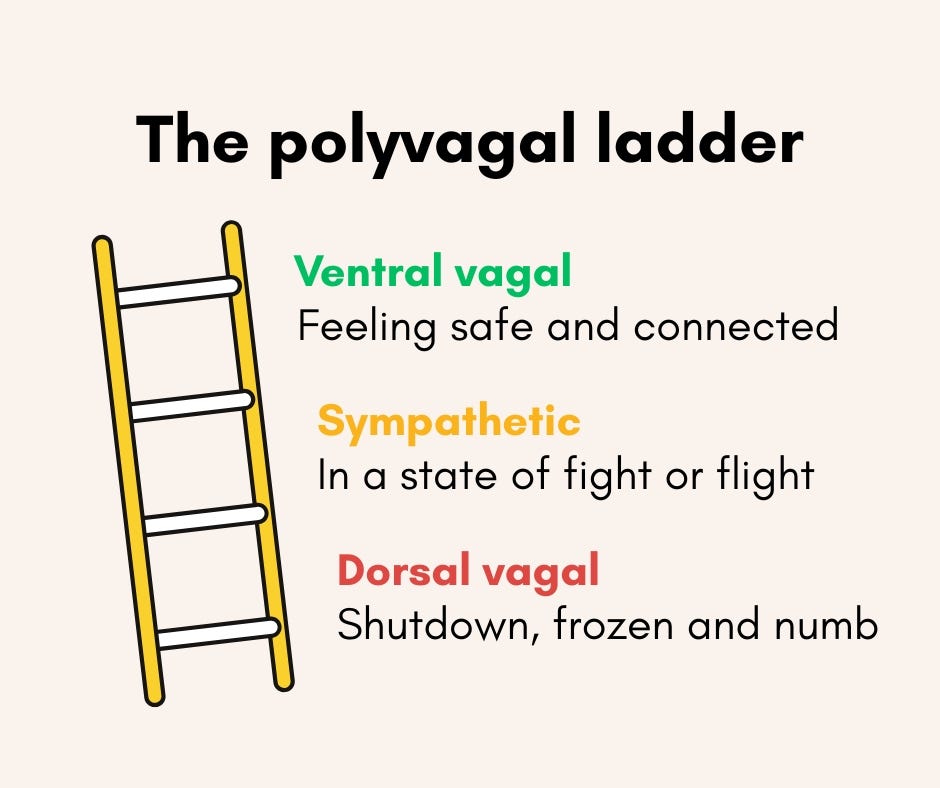
The top rung – Ventral vagal (safety and connection)
You feel calm, grounded, open, and able to connect. You can think clearly, make decisions, and respond flexibly to life.
The middle rung – Sympathetic (fight or flight)
Your body senses pressure or danger. You feel alert, anxious, tense, wired or restless. Your heart rate increases, and it’s hard to relax.
The bottom rung – Dorsal vagal (freeze or shutdown)
When things feel too much for too long, your system hits pause. You might feel tired, disconnected, numb, or detached – like your body is conserving energy. In this state you’re usually procrastinating and doomscrolling a lot.
You move up and down this ladder all day. For people with ADHD, those shifts can happen faster and more intensely. Your ladder is extra sensitive – it’s quick to react and quick to crash.
ADHD’ers spend a lot of time on the middle and bottom rung – simply because we have sensitive nervous systems – and we have a harder time climbing the ladder up to the top rung.
How to move up the ladder
The bottom rung: When you’re in a freeze state (dorsal vagal)
In a freeze state, your system is conserving energy. Everything feels flat, distant, or heavy. You’re dissociated, don’t feel present in your body, and you’re more likely to be overthinking, experience anxiety and hopelessness, and to doomscroll and procrastinate in this state.
To move up to the next rung on the ladder, your goal isn’t to meditate or calm down. It’s to gently invite your body back into awareness.
Try:
Moving a little – wiggle your toes, roll your shoulders, stretch your hands.
Looking around and naming five things you can see.
Taking one slow breath – not deep, just steady.
Feeling the texture of something nearby (your clothes, a blanket, a mug).
Letting light or fresh air in.
These small sensory shifts signal to your nervous system that it’s safe to come back online.
Here’s what happens when you leave the freeze state
Here’s the part most people don’t expect – coming out of the freeze state doesn’t instantly feel good.
As your body wakes up from the freeze state, you might feel a sudden surge of irritation, restlessness, agitation, or an urge to move.
That’s because you’re moving up the ladder – from dorsal vagal into sympathetic activation.
Your system is getting access to the energy that was previously shut down. It’s uncomfortable, but it’s a good sign. It means your body is coming back to life.
You might notice:
A spike of frustration or anger
A burst of energy that feels chaotic
The urge to move, fidget, or pace
This phase is temporary. The key is to work with that energy instead of trying to suppress it.
The middle rung: When you’re in fight or flight (sympathetic)
If you’re feeling restless, angry, panicked or have a sense of urgency, you’re in the state most commonly known as fight or flight.
Here, there’s a few steps you need to take.
First, you need to support your body in carrying through the action that your body is feeling called to do. This could look like:
Running
Shaking
Dancing
Moving in general
Try to tune into what your intuition is telling you to do. Are your legs exploding with energy? Then you may need to walk, run or lay on your back and kick your legs into the air.
If you feel like punching someone – okay, maybe you don’t punch a person. Maybe you punch a pillow or air-box. Or find a wall and push against it as hard as you can.
Second, when you’ve gotten the excess energy out of your body, you need to show your nervous system that you’re safe, and that there’s no longer a threat around.
Try:
Breathing out longer than you breathe in.
Sighing or gently swaying.
Grounding with your senses – what can you see, hear, touch, or smell right now?
Wrap yourself in a blanket, take a warm shower, or hold a warm mug.
Hum, sing softly, or listen to gentle rhythmic music.
Third, when you’ve calmed down, you can take it one step further and reconnect with yourself and others.
You might:
Journal or voice-note about what you’re feeling (naming emotions helps integrate them).
Talk to a trusted person who feels safe and grounded.
Do something that makes you feel present – cooking, drawing, gardening, listening to nature sounds.
Notice gratitude or comfort in small things (sunlight, warmth, texture, a good smell).
Cuddle with a pet or loved one.
By now you should have reached the top rung on the polyvagal ladder.
The top rung: When you reach safety (ventral vagal)
This is your calm, connected state where you can think clearly, be creative, and connect with others.
When you notice yourself here, pause and take it in.
Notice what safety feels like in your body – warmth in your chest, slower breath, softer muscles.
The more you pay attention to what feeling safe feels like, the easier it becomes to find your way back there next time.
You might feel tempted to try this…
Now, an overwhelmed part of you might think – “well, I’m on the bottom rung right now, why don’t I just go straight to the fight-or-flight practices, so I can get there quicker! I’ll just meditate, and I can get there.”
And I’d really like to advise you not to do that.
When you’re overwhelmed, your brain often wants to fix it right away – to leap from freeze straight into calm focus. But your nervous system doesn’t work that way.
Regulation is a process, not a switch you can flick with 20 minutes of meditation. You can’t think your way from shutdown to safety. You have to move up the ladder, one rung at a time.
If you try to skip steps – like forcing productivity while you’re still frozen, or meditating when you’re buzzing with anxiety – your body won’t believe you’re actually safe.
It needs gentle, physiological cues before it can settle.
Think of it like defrosting a turkey. You don’t grab a turkey straight from the freezer and throw it in the oven – it just doesn’t work; it’ll be overcooked on the outside and frozen in the middle. You need to slowly defrost it first.
Just like you need to slowly defrost your freeze state, before you can start working on moving towards the calm and connected state. Otherwise you might move yourself deeper into dysregulation, when you get more frustrated that it’s not working.
Remember: You won’t stay calm all of the time
Regulation doesn’t mean staying calm all the time. It means knowing where you are on the ladder – and having ways to move one step closer to safety when you need to.
You’ll still slide down sometimes. That’s okay. The goal isn’t to avoid the other rungs on the ladder (those states are there to help protect you), but to recover from being in those other states with compassion and awareness.
When you notice yourself frozen, anxious, or shut down, ask:
“What would help my body feel just a little safer right now?”
That question is the start of every climb.
Do you have a minute to check in with yourself?
Take a moment and ask yourself:
Which rung of the ladder do I tend to live on?
What usually helps me feel better when I’m in that state?
What does my body feel like when I’m truly calm and connected?
You don’t have to get to the top every time. Just find your next rung, and let that be enough for today.